
Currently Empty: ₹0.00
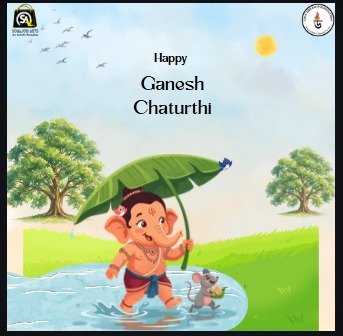
Ganesh Chaturthi: Celebrating the God of Wisdom, Prosperity and New Beginnings
India is a land where festivals are much more than occasions of celebration. They are deeply connected with faith, culture, family, community and timeless values. Among the many vibrant festivals celebrated across the country, Ganesh Chaturthi holds a special place in the hearts of millions of people.
Dedicated to Lord Ganesha, the beloved elephant-headed deity, Ganesh Chaturthi celebrates wisdom, prosperity, good fortune and the removal of obstacles. The festival is also a beautiful reminder that every ending can lead to a new beginning and that faith, perseverance and knowledge can help us overcome the challenges of life.
Every year, homes, temples, streets and community spaces come alive with beautifully decorated Ganesha idols, devotional songs, prayers, cultural programmes and the joyful chant of “Ganpati Bappa Morya!” The atmosphere is filled with devotion and enthusiasm as families and communities come together to welcome Lord Ganesha.
But behind the colour, music and celebration lies a deeper message—one that remains relevant even in the modern world.
Who Is Lord Ganesha?
Lord Ganesha is one of the most widely worshipped deities in Hinduism. He is traditionally regarded as the God of wisdom, knowledge, prosperity and new beginnings, and is also known as Vighnaharta, meaning the remover of obstacles.
Ganesha is often worshipped before beginning something important—a new business, a journey, an examination, a marriage, a new home or another significant undertaking. This tradition reflects the belief that seeking divine blessings at the beginning of an endeavour can bring clarity, confidence and success.
Lord Ganesha is also associated with intellectual ability and learning. His presence is therefore particularly meaningful for students, teachers, artists, professionals and anyone beginning a new chapter in life.
His unique appearance itself carries symbolism. Every part of Ganesha’s form is traditionally associated with a particular quality or lesson.
His large ears remind us to listen carefully. His small eyes encourage concentration and attention. His large head represents wisdom and broad thinking, while his trunk symbolises adaptability and strength.
Together, these qualities offer a powerful philosophy for life.
The Story Behind Ganesh Chaturthi
According to Hindu tradition, Lord Ganesha was created by Goddess Parvati. She formed Ganesha from sandalwood paste or the material of her body, depending on different versions of the traditional story, and gave him the responsibility of guarding her while she bathed.
When Lord Shiva returned and attempted to enter, Ganesha stopped him because he was following his mother’s instructions. A confrontation followed, and Shiva eventually severed Ganesha’s head.
When Parvati discovered what had happened, she was devastated and demanded that Ganesha be restored. To console her and bring Ganesha back to life, Shiva gave him the head of an elephant.
Thus, Ganesha received his distinctive elephant head and became a beloved divine figure.
The story is not simply about the origin of a deity. It also carries deeper lessons about duty, obedience, love, transformation and reconciliation.
Ganesha’s story reminds us that life can sometimes take unexpected turns. Something that initially appears to be a tragedy or an ending can become the beginning of something new.
Why Is Ganesh Chaturthi Celebrated?
Ganesh Chaturthi marks the birth of Lord Ganesha and is traditionally observed on the fourth day of the Hindu lunar month of Bhadrapada.
The festival is celebrated with great enthusiasm in many parts of India, particularly in Maharashtra, Karnataka, Goa, Andhra Pradesh, Telangana, Tamil Nadu and several other regions. Over time, Ganesh Chaturthi has also become increasingly popular in cities and communities across the country.
During the festival, devotees bring Ganesha idols into their homes or community pandals. The idol is worshipped through prayers, offerings, devotional songs and rituals.
The celebration traditionally continues for several days, with the duration varying according to local customs and family traditions.
The festival concludes with Visarjan, when the idol is carried in a procession and immersed in water.
The immersion carries a profound spiritual message: everything in the material world is temporary. We welcome Ganesha with love and devotion, celebrate his presence and eventually bid him farewell with the hope that he will return again.
The Meaning of Ganpati Bappa Morya
One of the most recognisable sounds of Ganesh Chaturthi is:
“Ganpati Bappa Morya!”
The chant expresses devotion, affection and celebration. People repeat it during processions, prayers and the final immersion ceremony.
It represents the emotional relationship between devotees and Lord Ganesha. He is not viewed merely as a distant divine figure but as a beloved presence welcomed into homes and communities.
The emotional farewell during Visarjan is therefore both joyful and touching.
Devotees believe that although the physical idol is immersed, the blessings and teachings of Lord Ganesha remain with them.
The Symbolism of Lord Ganesha
Perhaps one of the most fascinating aspects of Lord Ganesha is the symbolism associated with his appearance.
The Elephant Head – Wisdom and Intelligence
The elephant is traditionally associated with intelligence, memory and strength. Ganesha’s elephant head represents wisdom and the ability to understand life’s complexities.
In today’s world, where people are surrounded by enormous amounts of information, knowledge alone is not enough. We also need wisdom—the ability to understand, evaluate and use knowledge responsibly.
The Large Ears – The Importance of Listening
Ganesha’s large ears remind us to listen.
Modern life is often dominated by constant talking, notifications, opinions and arguments. We frequently want to be heard but forget the importance of listening.
Good communication begins with listening.
Whether in a family, workplace, classroom or community, the ability to listen patiently can prevent misunderstandings and strengthen relationships.
The Small Eyes – Concentration
Ganesha’s small eyes symbolise focus and concentration.
Success rarely comes from scattered attention. Whether a student is preparing for an examination or a professional is building a career, meaningful achievement requires the ability to concentrate on a goal.
In an age of smartphones and endless digital distractions, this lesson is more relevant than ever.
The Large Belly – Acceptance and Balance
Ganesha’s large belly is often interpreted as the ability to absorb and digest both the good and difficult experiences of life.
Life will inevitably bring happiness, disappointment, success, failure, praise and criticism.
We cannot control everything that happens to us, but we can control how we respond.
Ganesha reminds us to develop emotional strength and maintain balance.
The Trunk – Adaptability
An elephant’s trunk is incredibly strong yet remarkably flexible.
This represents an important lesson: strength and flexibility can exist together.
A successful person must know when to stand firmly by their principles and when to adapt to changing circumstances.
Adaptability is especially important in today’s rapidly changing world.
Ganesh Chaturthi and New Beginnings
Perhaps the most important message of Ganesh Chaturthi is the celebration of new beginnings.
Lord Ganesha is traditionally worshipped before starting something new because every beginning brings uncertainty.
A new job, a business, an educational journey, a marriage, a move to a new city or even a personal transformation can bring challenges.
We may not know what lies ahead.
Yet every journey must begin somewhere.
Ganesh Chaturthi encourages us to begin with faith, wisdom and positive intentions.
The festival teaches us not to fear obstacles. Instead, we should face them with courage and intelligence.
After all, the presence of obstacles does not mean that the journey should stop.
Sometimes obstacles simply require us to find another path.
The Lesson of Removing Obstacles
Lord Ganesha is known as Vighnaharta—the remover of obstacles.
However, the deeper meaning is not necessarily that life will become completely free of difficulties.
Instead, the symbolism encourages us to develop the wisdom and strength necessary to overcome them.
A student may face academic difficulties.
A professional may experience career setbacks.
An entrepreneur may face financial challenges.
A family may go through difficult circumstances.
No life is completely free from obstacles.
The important question is how we respond to them.
Ganesh Chaturthi reminds us that obstacles can become opportunities for learning, growth and transformation.
Ganesh Chaturthi and Family Values
Ganesh Chaturthi is also a festival of togetherness.
Families often come together to install the idol, prepare offerings, decorate their homes, participate in prayers and share traditional food.
Children learn about culture and traditions from parents and grandparents. Younger generations participate in artistic and cultural activities while older generations pass down stories and values.
In a rapidly changing world, such moments of togetherness are extremely valuable.
Festivals create opportunities for families to pause their busy routines and spend meaningful time together.
The celebration therefore becomes more than a religious observance—it becomes a way of strengthening relationships.
Ganesh Chaturthi and Community Spirit
The festival has also developed into a major community celebration in many parts of India.
Neighbourhoods organise public pandals, cultural programmes, music, dance and social activities.
People from different backgrounds often participate together.
This community spirit represents another important message of Ganesh Chaturthi: celebration becomes more meaningful when it brings people together rather than separating them.
A festival can become a platform for friendship, cooperation and social responsibility.
Many communities also use the occasion to organise charitable activities, blood donation camps, educational initiatives and other social programmes.
Thus, devotion can be transformed into service.
Celebrating an Eco-Friendly Ganesh Chaturthi
While celebrating tradition, it is equally important to protect the environment.
The increasing use of large idols and non-biodegradable materials has raised concerns about pollution associated with immersion ceremonies.
An eco-friendly Ganesh Chaturthi can help preserve both faith and nature.
Devotees can consider idols made from natural clay and environmentally friendly materials. Natural colours can be preferred over harmful chemical paints, and decorations can use flowers, leaves, cloth, paper and reusable materials.
The idea is simple: our celebrations should not harm the environment that sustains us.
An eco-friendly celebration demonstrates that tradition and environmental responsibility can coexist.
Ganesh Chaturthi and Indian Art
Ganesh Chaturthi is also a wonderful celebration of India’s artistic heritage.
Ganesha idols are created by skilled artisans using clay, wood, metal and other materials. Every region has its own artistic traditions and visual styles.
From traditional craftsmanship to contemporary artistic interpretations, Ganesha has inspired countless artists and craftspeople.
The festival therefore provides an opportunity to appreciate and support India’s artisan communities.
Purchasing handcrafted decorations, traditional artwork and locally made products can help sustain artisans while keeping India’s rich cultural heritage alive.
When we celebrate Indian festivals through handmade art and crafts, we are not simply purchasing an object—we are supporting the creativity, skill and livelihood of the person who made it.
What Lord Ganesha Teaches the Modern Generation
The teachings associated with Lord Ganesha are particularly relevant to today’s younger generation.
Learn continuously.
Knowledge is a lifelong journey. We should never stop learning.
Listen before speaking.
Good leaders and successful individuals understand the value of listening.
Stay focused.
Distractions are everywhere, but meaningful achievement requires concentration.
Be adaptable.
The world changes constantly. Those who can adapt without losing their core values are better prepared for the future.
Accept failure.
Failure is not the opposite of success. It is often part of the journey towards success.
Respect your roots.
Modernity does not require us to abandon tradition. We can embrace technology and progress while remaining connected to our cultural heritage.
Begin with courage.
Every major achievement starts with a first step.
The Deeper Meaning of Visarjan
The final day of Ganesh Chaturthi is often filled with both celebration and emotion.
Devotees carry the idol in a procession accompanied by music, dance and chants before immersing it in water.
At first glance, Visarjan may appear to be simply the end of the festival. But symbolically, it represents something much deeper.
The idol that was created from natural material eventually returns to nature.
This reflects the ancient idea that everything material is temporary.
We welcome, celebrate and eventually let go.
Visarjan teaches us the importance of acceptance and detachment. It reminds us that while circumstances may change, the values and memories we carry forward remain.
And as devotees say, “Ganpati Bappa Morya, Pudchya Varshi Lavkar Ya”—Lord Ganesha, return soon next year.
The farewell therefore contains the promise of another beginning.
A Festival of Faith, Wisdom and Hope
Ganesh Chaturthi is much more than the installation of an idol or a series of rituals.
It is a celebration of wisdom over ignorance, courage over fear and hope over uncertainty.
It reminds us to begin our journeys with positive intentions, to face obstacles with determination and to remain humble even when we achieve success.
Lord Ganesha’s form itself teaches us how to live: listen carefully, observe deeply, think wisely, adapt when necessary and remain grounded.
In a world that is moving faster every day, these timeless lessons have enormous value.
Conclusion
Ganesh Chaturthi is a celebration of faith, culture, art, family, community and new beginnings.
It brings people together and connects generations with India’s rich cultural traditions. At the same time, it offers lessons that extend far beyond religious practice.
Lord Ganesha reminds us that wisdom is more powerful than information, patience is stronger than anger, adaptability is essential for growth and obstacles can be transformed into opportunities.
As we welcome Ganesha into our homes and hearts, let us celebrate not only the festival but also the values he represents.
Let us begin new journeys with courage.
Let us overcome challenges with wisdom.
Let us celebrate success with humility.
Let us support our communities and artisans.
And let us remember that every ending can carry within it the possibility of a new beginning.
Ganpati Bappa Morya!
May Lord Ganesha bless every home with wisdom, happiness, prosperity and the strength to overcome every obstacle.
